2026 Home Entertainment Tech: 3 Must-Have Devices for US Living Rooms
Advertisements
The 2026 Guide to Home Entertainment Tech reveals three crucial devices—advanced projectors, immersive sound systems, and AI-powered smart hubs—that will redefine the United States living room experience.
Welcome to the future of leisure! As we approach 2026, the landscape of home entertainment is undergoing a significant transformation, promising an unparalleled immersive experience right in your living room. This guide delves into the essential devices that will shape the 2026 guide to home entertainment tech: 3 must-have devices for an immersive United States living room experience, elevating your media consumption to new heights.
The Evolution of Visuals: Advanced Projectors and MicroLED Displays
The visual centerpiece of any home entertainment setup is paramount, and by 2026, traditional televisions are facing stiff competition from more dynamic and flexible display technologies. We are moving beyond mere resolution, focusing on seamless integration, visual fidelity, and adaptable viewing experiences.
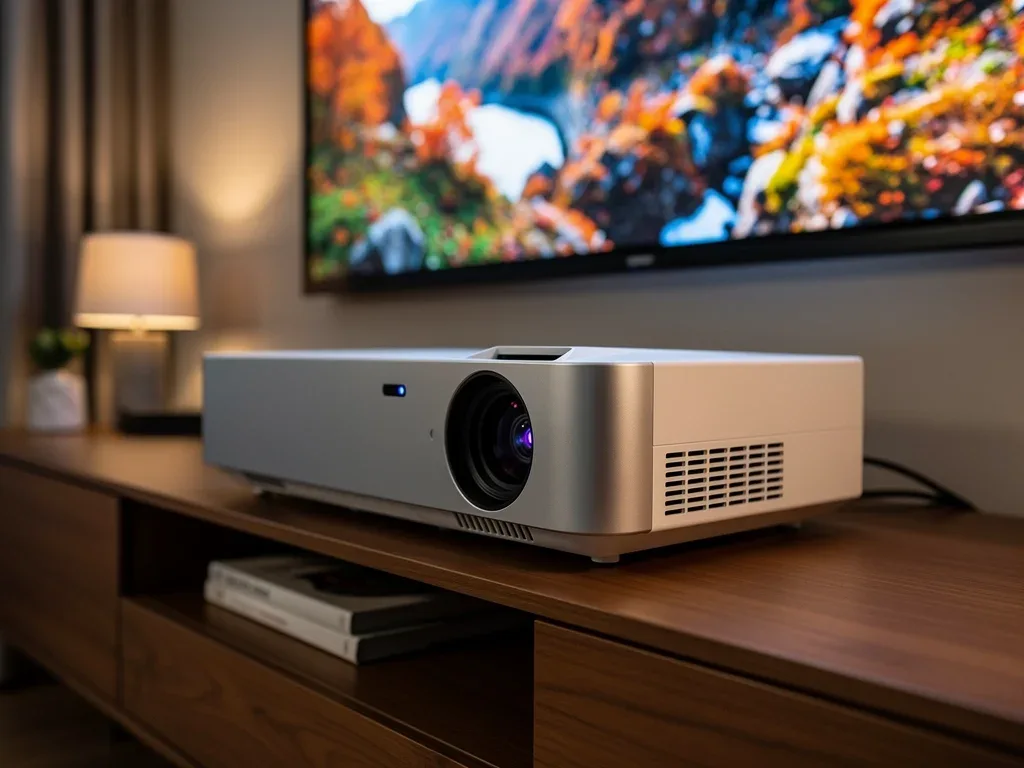
Gone are the days when projectors were relegated to dimly lit basements or dedicated home theaters. Today’s advanced projectors, particularly ultra-short throw (UST) laser models, are designed to blend seamlessly into any living room, offering massive screen sizes without the need for extensive installation or distance. These devices project vibrant, high-contrast images onto specialized screens or even directly onto walls, making them a formidable alternative to large-format TVs.
Ultra-Short Throw Laser Projectors: The New Living Room Standard
UST laser projectors are revolutionizing how we think about home displays. Their ability to cast a huge image from just inches away from the wall means they can be placed on a standard TV console, eliminating ceiling mounts and cable clutter. The laser light sources provide incredible brightness and color accuracy, ensuring a stunning picture even in well-lit rooms.
- Space Efficiency: Eliminates the need for a dedicated projection room or long throw distances.
- Large Screen Sizes: Easily achieves 100-inch or larger displays for a truly cinematic feel.
- Vibrant Colors & Brightness: Laser technology delivers superior image quality compared to traditional lamps.
- Longevity: Laser light sources last significantly longer than conventional projector lamps.
MicroLED Displays: The Premium Visual Experience
While UST projectors offer flexibility and scale, MicroLED displays represent the pinnacle of visual technology for those seeking uncompromising quality. Unlike OLED, MicroLED uses individual microscopic LEDs for each pixel, providing perfect blacks, incredible brightness, and no risk of burn-in. Though still a premium option, their modular nature allows for custom sizes and shapes, making them highly desirable for bespoke home entertainment systems.
The visual landscape of home entertainment in 2026 is defined by choice: the expansive, flexible canvas of advanced projectors, or the ultimate, pixel-perfect clarity of MicroLED. Both technologies offer significant upgrades over previous generations, promising a truly immersive viewing experience tailored to individual preferences and living spaces.
Immersive Audio Systems: Beyond Surround Sound
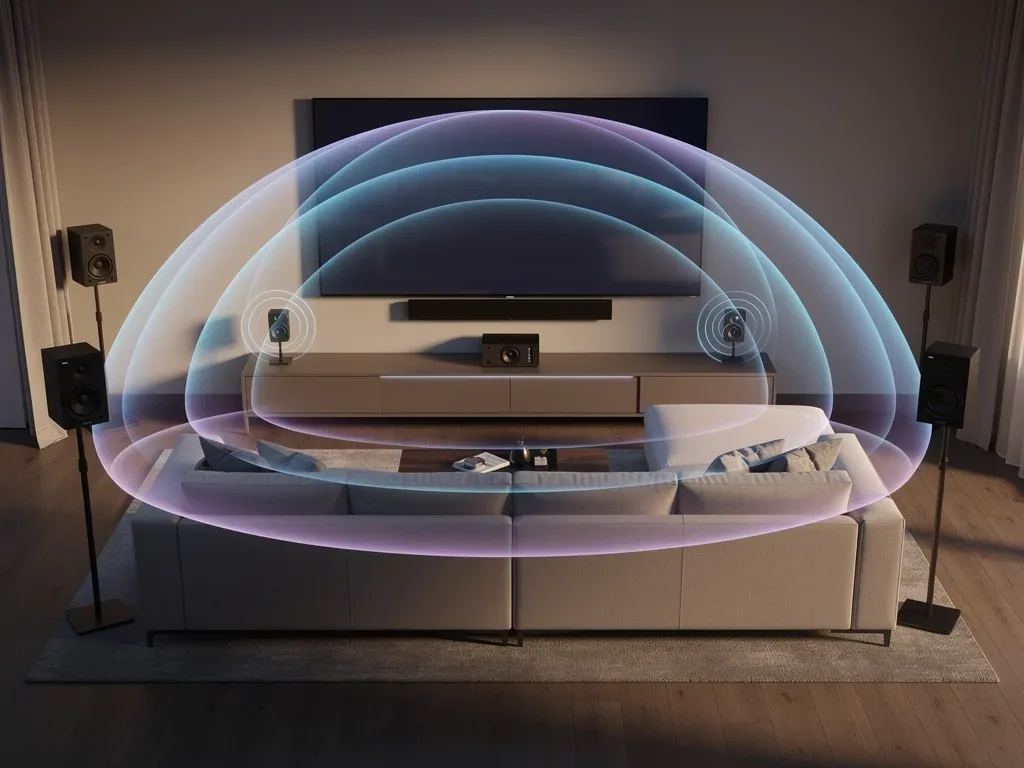
A truly immersive home entertainment experience is incomplete without audio that transports you directly into the action. By 2026, audio technology has evolved far beyond traditional 5.1 or 7.1 surround sound, embracing spatial audio formats and intelligent soundscapes that adapt to your environment. These systems are designed to create a dome of sound, where every whisper and explosion feels incredibly lifelike and precisely placed.
The focus has shifted from simply having speakers around the room to creating a three-dimensional sound field. This is achieved through a combination of advanced speaker technology, sophisticated digital signal processing, and a deeper understanding of psychoacoustics. The result is an audio experience that not only envelops you but also provides a sense of height and depth, making you feel truly present in the scene.
Dolby Atmos and DTS:X Integration: Heightened Realism
These object-based audio formats are now standard in high-end home entertainment systems. Instead of channels, sounds are treated as individual objects that can be precisely placed and moved anywhere in a 3D space, including overhead. This capability is crucial for creating realistic effects like rain falling from above or an airplane flying overhead.
- Overhead Sound: Adds a new dimension to audio, making effects like rain or helicopters more convincing.
- Object-Based Audio: Sounds move independently, creating a more dynamic and realistic soundscape.
- Enhanced Immersion: Places you at the center of the action, blurring the lines between fiction and reality.
- Scalability: Systems can range from soundbars with upward-firing speakers to full multi-speaker setups.
Wireless Multi-Room Audio and Adaptive Soundbars
The convenience of wireless technology has made multi-room audio systems more accessible and integrated than ever. Speakers can communicate seamlessly, allowing for synchronized playback across different zones or individual audio streams. Furthermore, advanced soundbars now incorporate adaptive sound technologies that analyze your room’s acoustics and adjust the audio output for optimal performance, regardless of speaker placement or room shape.
By 2026, an immersive audio system isn’t just about powerful speakers; it’s about intelligent sound that adapts to your space and transports you into the heart of your content. Whether it’s the subtle nuances of a musical performance or the thunderous roar of a blockbuster, the audio experience will be as captivating as the visuals.
AI-Powered Smart Home Hubs: The Orchestrators of Entertainment
The third indispensable device for a truly immersive home entertainment experience in 2026 isn’t a display or a speaker, but the intelligent core that ties everything together: the AI-powered smart home hub. These advanced hubs transcend simple voice commands, becoming intuitive orchestrators of your entire living space, anticipating your needs and seamlessly integrating all your entertainment components.
These hubs are no longer just about turning lights on or off. They are sophisticated systems that learn your preferences, automate complex routines, and provide a unified control interface for all your devices. From adjusting lighting and temperature to queuing up your favorite content and optimizing audio settings, the smart home hub ensures a frictionless and personalized entertainment journey.
Unified Control and Automation: Simplifying Complexity
The proliferation of smart devices often leads to a fragmented user experience, with multiple apps and interfaces. AI-powered smart home hubs solve this by providing a single point of control for everything. They can initiate complex scenarios with a single command or even automatically based on triggers like time of day, presence detection, or media playback.
- Centralized Management: Control all smart devices from a single, intuitive interface.
- Contextual Automation: Systems learn preferences and automate tasks based on user behavior and external factors.
- Voice and Gesture Control: Natural interaction methods make controlling your environment effortless.
- Personalized Experiences: Tailors lighting, audio, and content suggestions to individual users.
Predictive Intelligence and Adaptive Environments
The true power of 2026’s smart hubs lies in their predictive capabilities. Leveraging machine learning, they can anticipate your entertainment desires. Imagine walking into your living room, and the lights automatically dim, the blinds close, your preferred music genre begins to play softly, and the projector powers on, ready for your command. This level of seamless integration and foresight transforms a collection of devices into a cohesive, intelligent environment.
The AI-powered smart home hub is the unsung hero of modern home entertainment. It transforms a collection of high-tech gadgets into a harmonious symphony, making your immersive living room experience not just possible, but effortlessly enjoyable and deeply personalized. This is the device that ensures your technology works for you, not the other way around.
Seamless Integration: The Future of Connectivity
Beyond individual devices, the true magic of 2026 home entertainment lies in the seamless integration and interoperability of all components. This isn’t just about devices talking to each other; it’s about them working in concert to create a cohesive and intuitive user experience. The era of proprietary ecosystems is giving way to open standards and universal compatibility, driven by consumer demand for flexibility and ease of use.
Imagine a scenario where your projector, sound system, and smart lighting communicate effortlessly with your AI hub, responding to your mood or the content you’re consuming. This level of synergy enhances immersion and simplifies control, making technology feel invisible yet profoundly impactful. The focus is on creating an environment that responds to you, rather than you having to constantly interact with it.
Universal Connectivity Standards: Matter and Thread
The adoption of universal smart home standards like Matter and Thread is crucial in achieving this seamless integration. These protocols allow devices from different manufacturers to communicate and work together reliably, eliminating compatibility headaches. This means you can mix and match components from various brands, confident that they will function as a unified system.
- Enhanced Compatibility: Devices from different brands can seamlessly interact.
- Improved Reliability: Robust protocols ensure consistent and stable connections.
- Simplified Setup: Easier pairing and configuration of new smart home devices.
- Future-Proofing: Ensures your smart home ecosystem remains relevant and expandable.
Edge Computing and Local Processing: Faster, More Secure
To further enhance responsiveness and data privacy, many smart home systems are moving towards edge computing, where much of the data processing happens locally on the device or hub, rather than in the cloud. This reduces latency, improves security, and allows for quicker reactions to commands and environmental changes, making your entertainment experience more immediate and reliable.

The future of home entertainment connectivity is about creating an intelligent, responsive, and secure environment. Seamless integration means that your focus can remain on enjoying your content, while the underlying technology works tirelessly and invisibly to optimize every aspect of your immersive living room experience.
Personalization and Adaptive Content Delivery
In 2026, home entertainment is no longer a one-size-fits-all proposition. The convergence of advanced hardware and intelligent software allows for unprecedented levels of personalization and adaptive content delivery. Your living room doesn’t just play content; it understands your preferences, anticipates your desires, and tailors the entire experience to you and your household.
This goes beyond simple recommendations. We’re talking about dynamic adjustments to visual and audio settings based on who is watching, their mood, or even ambient conditions. The goal is to create an entertainment space that feels uniquely yours, evolving with your tastes and providing a consistently optimized experience without constant manual intervention.
AI-Driven Content Curation and Recommendation Engines
Next-generation AI recommendation engines are far more sophisticated than their predecessors. They analyze not only your viewing history but also contextual cues like time of day, current events, and even biometric data (with user consent) to suggest content that genuinely resonates. These systems learn your preferences across various platforms, offering a unified and personalized content feed.
- Deep Learning Algorithms: Understands nuanced preferences for more accurate suggestions.
- Cross-Platform Integration: Recommends content from all your subscribed services.
- Contextual Awareness: Factors in external data for highly relevant suggestions.
- Interactive Content: Some content adapts storylines or endings based on viewer choices.
Adaptive Visual and Audio Profiles
Your immersive audio and visual systems will automatically adjust settings based on the content type and viewer. For instance, a documentary might trigger a warmer color palette and subtle background music, while an action movie could activate dynamic HDR modes and a more aggressive spatial audio profile. These adjustments happen in real-time, ensuring optimal presentation for every piece of media.
Personalization and adaptive content delivery are transforming home entertainment into a truly bespoke experience. By 2026, your living room will not just be a place to consume media, but a dynamic, intelligent space that caters precisely to your individual tastes and moods, making every viewing session uniquely engaging.
The Role of Sustainability and User-Centric Design
As technology advances, so does our awareness of its environmental impact and the importance of user experience. By 2026, the home entertainment industry is placing a significant emphasis on sustainability and user-centric design. This means not only creating devices that are energy-efficient and built with recyclable materials but also designing interfaces and systems that are intuitive, accessible, and truly enhance daily life without unnecessary complexity.
Consumers are increasingly seeking products that align with their values, and manufacturers are responding by integrating eco-friendly practices throughout the product lifecycle. Furthermore, the focus on user-centric design ensures that despite the technological sophistication, the experience remains approachable and enjoyable for everyone, regardless of their tech savviness.
Energy Efficiency and Eco-Friendly Manufacturing
New regulations and consumer demand are driving innovations in energy efficiency for all home entertainment devices. This includes low-power standby modes, efficient display technologies like MicroLED and laser projectors, and smart power management features integrated into AI hubs. Manufacturers are also exploring the use of recycled and sustainably sourced materials in their products and packaging.
- Reduced Power Consumption: Lower electricity bills and environmental footprint.
- Recycled Materials: Minimizing waste and promoting circular economy principles.
- Modular Design: Easier repairs and upgrades, extending product lifespan.
- Ethical Sourcing: Ensuring components are sourced responsibly and sustainably.
Intuitive Interfaces and Accessibility Features
User-centric design prioritizes ease of use and accessibility. This translates into simplified remote controls, highly intuitive voice and gesture interfaces, and robust accessibility features for individuals with diverse needs. The goal is to make advanced technology feel natural and effortless, removing barriers to enjoyment for all users.
The commitment to sustainability and user-centric design in 2026 ensures that the future of home entertainment is not only technologically advanced but also responsible and inclusive. These principles guide the development of devices that are powerful, enjoyable, and mindful of their impact on both people and the planet, truly enriching the living room experience.
Securing Your Immersive Experience: Privacy and Cybersecurity in 2026
With the increasing interconnectedness of home entertainment systems, the importance of privacy and cybersecurity has never been greater. As AI-powered hubs and smart devices gather more data to personalize experiences, safeguarding this information becomes paramount. By 2026, robust security protocols and transparent privacy policies are not just desirable features but essential components of any trustworthy home entertainment setup.
Consumers are more aware of their digital footprint, and manufacturers are responding with advanced encryption, secure authentication methods, and clear control over data sharing. The goal is to provide an immersive experience without compromising personal information or exposing your home network to vulnerabilities.
Advanced Encryption and Data Protection
All data transmitted within your home entertainment ecosystem, from voice commands to content streams, is secured with state-of-the-art encryption. Devices are designed with privacy by design principles, ensuring that personal data is minimized, anonymized, and processed locally whenever possible. Regular security updates are pushed automatically to protect against emerging threats.
- End-to-End Encryption: Protects data in transit and at rest.
- Local Processing: Reduces reliance on cloud servers for sensitive data.
- Regular Security Patches: Keeps systems updated against new vulnerabilities.
- Data Minimization: Only necessary data is collected and stored.
User Control and Transparency in Privacy Settings
Empowering users with granular control over their privacy settings is a cornerstone of 2026 home entertainment tech. Dashboards offer clear visibility into what data is being collected and how it’s used, allowing users to easily opt-in or opt-out of specific features. Clear, concise privacy policies replace convoluted legal jargon, fostering trust and informed decision-making.
The security of your home entertainment system is as crucial as its immersive capabilities. By 2026, manufacturers prioritize user privacy and cybersecurity, ensuring that your journey into advanced media consumption is not only captivating but also safe and secure. This commitment builds trust and allows users to fully embrace the future of their connected living rooms without apprehension.
| Key Device | Core Benefit for 2026 |
|---|---|
| Advanced Projectors | Delivers massive, flexible, and high-fidelity visuals, transforming any wall into a cinematic screen. |
| Immersive Audio Systems | Creates a 3D soundscape with object-based audio, providing unparalleled realism and depth. |
| AI-Powered Smart Hubs | Orchestrates all devices for seamless control, automation, and personalized entertainment experiences. |
| Seamless Integration | Ensures all devices work harmoniously, simplifying control and enhancing the overall user experience. |
Frequently Asked Questions About 2026 Home Entertainment Tech
What makes ultra-short throw projectors ideal for 2026 living rooms?▼Ultra-short throw (UST) projectors are perfect for 2026 living rooms because they can project large, high-quality images from just inches away from the wall. This eliminates the need for extensive installation or dedicated home theater space, offering cinematic visuals in any room without clutter.
How do immersive audio systems go beyond traditional surround sound?▼Immersive audio systems, like those with Dolby Atmos, utilize object-based audio to create a three-dimensional sound field, including overhead effects. This allows sounds to be precisely placed and moved in space, providing a more realistic and enveloping audio experience than older channel-based systems.
What role do AI-powered smart home hubs play in 2026 home entertainment?▼AI-powered smart home hubs serve as the central orchestrator for all entertainment devices. They learn user preferences, automate routines, and provide unified control over visuals, audio, and lighting, creating a personalized and seamless immersive experience without manual adjustments.
Are MicroLED displays a practical option for home entertainment in 2026?▼While still premium, MicroLED displays are becoming more accessible. They offer unparalleled visual quality with perfect blacks and extreme brightness, without burn-in risks. Their modular design allows for custom sizing, making them a highly desirable choice for discerning users seeking the ultimate visual experience.
How does sustainability factor into 2026 home entertainment tech?▼Sustainability is a key focus, with devices designed for energy efficiency, using recycled materials, and offering modular designs for longevity. Manufacturers are also implementing ethical sourcing and transparent production processes to minimize environmental impact, aligning with consumer demand for eco-friendly products.
Conclusion
The year 2026 promises a revolutionary shift in how we experience home entertainment, moving beyond passive viewing to truly immersive and interactive environments. The confluence of advanced projectors, sophisticated immersive audio systems, and intelligent AI-powered smart home hubs will redefine the living room experience in the United States. These three essential devices, working in harmony through seamless integration and driven by personalized content delivery, will transform your home into a dynamic hub of entertainment. As we embrace these technological advancements, the focus remains on creating a user-centric, sustainable, and secure future where every moment of media consumption is an unforgettable journey.